Spiral Art
What connects spiral art to ancient empires, modern technology, and everything in between? More than you'd expect.
At a Glance
- Subject: Spiral Art
- Category: Visual Arts, Geometry, Psychology


The Spiral's Ancient Origins
The spiral pattern is one of the oldest and most ubiquitous artistic motifs in human history. Archaeological evidence suggests that spiral designs were first used by Stone Age cultures as far back as 35,000 years ago, adorning cave walls, tools, and jewelry. From the coiled snakes of ancient Mesopotamia to the spiraling mandalas of India, the simple yet captivating spiral shape has held deep cultural and symbolic significance for civilizations across the globe.
Perhaps the most iconic example of ancient spiral art is the Newgrange monument in Ireland, a 5,000-year-old passage tomb decorated with intricate spiral carvings. Researchers believe these spirals may have been imbued with cosmological meaning, potentially aligning with the rising and setting of the sun on the winter solstice.
The Fibonacci Sequence and the "Golden Ratio"
The mathematical patterns underlying many natural spiral forms have long fascinated artists, philosophers, and scientists. In the 13th century, Italian mathematician Leonardo of Pisa (also known as Fibonacci) described a numerical sequence where each number is the sum of the two preceding ones: 0, 1, 1, 2, 3, 5, 8, 13, 21, and so on. This Fibonacci sequence has an intriguing property — the ratio between consecutive Fibonacci numbers steadily approaches the "golden ratio" of approximately 1.618, a proportion long revered for its aesthetic elegance.
"There is no doubt that the golden ratio, the Fibonacci sequence, and their manifestation in natural spirals have exerted a powerful influence on the human psyche and on the course of civilization."
— Mario Livio, astrophysicist and author
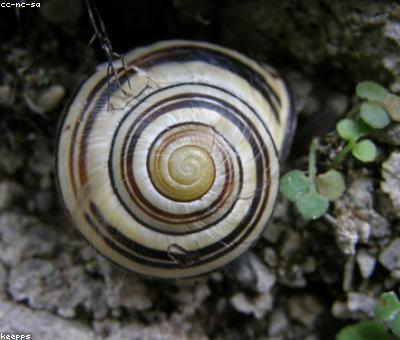
From the spiral patterns in seashells, sunflowers, and galaxies to the proportions of the human body, the golden ratio's presence in nature has inspired artists, architects, and scientists for centuries. Spiral art harnesses this universal mathematical order, using it to create visually captivating and psychologically resonant works.

The Lure of the Labyrinth
The spiral's ability to draw the eye inward has long been leveraged in the design of labyrinths and mazes — ancient spiritual and contemplative tools found across diverse cultures. Unlike a maze with multiple paths and dead ends, a labyrinth has a single, winding route to the center, an archetypical journey of self-discovery and transformation.
Spiral labyrinths, with their continuous looping path, have a particularly hypnotic and mesmerizing quality. The experience of tracing the spiral inward can evoke a sense of timelessness and unity with the greater natural order. This makes spiral labyrinths powerful tools for ritual, healing, and personal growth practices in both historical and contemporary contexts.

Fractals and the Digital Age
The advent of computer graphics in the 20th century unlocked new frontiers for spiral art, enabling the creation of mathematically-generated "fractal" patterns of breathtaking complexity. Fractals are infinitely self-similar geometric shapes that repeat at every scale, mirroring the recursive patterns found throughout the natural world.
The intricate, spiraling fractals generated by algorithms like the Mandelbrot set have become a hallmark of digital art and visualizations. These mesmerizing, infinitely-zooming images capture the essence of the spiral as a window into the hidden mathematical order underlying the universe.
As digital tools continue to evolve, spiral art is expanding into immersive, interactive realms. From virtual reality art experiences to AI-generated spiral artworks, the ancient symbol is finding new life in the modern age.
The Enduring Allure of Spiral Art
Whether rendered in stone, paint, code, or light, spiral art persists as a captivating visual idiom, one that speaks to the fundamental patterns underlying existence itself. By channeling the spiral's primal power — its dynamism, its connection to natural cycles, its capacity to induce altered states of consciousness — artists continue to create works that resonate across cultures and time periods.
As we gaze into the swirling vortexes of these timeless designs, we are invited to ponder our place in the grand spiral of the cosmos, to get lost in the labyrinth of our own minds, and to glimpse the hidden mathematical harmonies that govern our world. The spiral's allure is as eternal as the shape itself.
Comments