Quantum Decoherence
The deeper you look into quantum decoherence, the stranger and more fascinating it becomes.
At a Glance
- Subject: Quantum Decoherence
- Category: Quantum Physics
- First Described: Early 20th century, with foundational work by Erwin Schrödinger and Max Born
- Core Concept: The process by which quantum systems lose their quantum properties due to interaction with their environment
- Relevance: Explains why macroscopic objects do not display quantum superpositions in everyday life

The Invisible Wall Between Quantum and Classical Reality
Imagine Schrödinger's cat, both alive and dead, simultaneously — until someone opens the box. That thought experiment, proposed in 1935, isn't just a philosophical joke. It embodies the perplexing question of why quantum superpositions seem to vanish when we look at the world around us. The answer lies in quantum decoherence, a phenomenon that acts as an invisible wall, preventing quantum weirdness from spilling into our everyday experience.
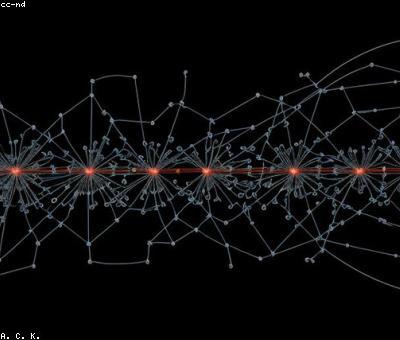
Decoherence occurs when a quantum system interacts with its surroundings — air molecules, photons, or even cosmic radiation — entangling itself in a web of environmental influences. Suddenly, what was a delicate superposition becomes an incoherent mixture of states. But wait, really? This process doesn’t destroy the quantum state outright; it merely renders it inaccessible, hiding its superpositions behind a curtain of environmental noise.
The Mechanics of Decoherence: How the Environment Shapes Quantum Fate
At its core, quantum decoherence is about entanglement. When a tiny quantum particle interacts with countless particles in the environment, their combined wave function becomes inseparably linked. As the environment "measures" certain properties — like position or spin — the system's superposition "collapses" into a classical mixture.
This rapid process is why maintaining quantum coherence in systems like qubits for quantum computers is so challenging. Even the tiniest disturbance, such as a stray photon or thermal vibration, can cause a superposition to decohere almost instantaneously. Researchers have found that isolating quantum systems from environmental noise is like trying to keep a soap bubble intact amid a hurricane.

Decoherence in the Cosmos: How the Universe Shapes Quantum Outcomes
Surprisingly, quantum decoherence isn't just a lab phenomenon — it's woven into the very fabric of the universe. During the early moments after the Big Bang, decoherence played a pivotal role in shaping the classical universe we observe today.
Think about the cosmic microwave background radiation — faint afterglow of the universe's infancy. The tiny quantum fluctuations that seeded galaxies underwent decoherence, transforming quantum fuzziness into classical structures. Without decoherence, the universe might still be a chaotic quantum soup, with no clear distinction between past and future.
Some physicists, like Dr. Elena Vassilev from the University of Sofia, argue that decoherence provides a natural explanation for the "arrow of time," as it irreversibly transforms quantum possibilities into definite classical realities.
Can Decoherence Be Reversed? The Myth of Quantum Undo
Here’s where things get even more intriguing. While decoherence appears to be an almost unstoppable process, in principle, it’s reversible. In a controlled environment, physicists have demonstrated "quantum echo" experiments where they partially rewind the decoherence process, restoring coherence. But — wait, really? It’s only feasible for tiny systems, not for the vast, messy environments of real-world objects.
“Decoherence is like whispering a secret into the universe. It can be remembered in a lab, but not in the chaos of everyday life,” says Dr. Marcus Liu, a pioneer in quantum error correction.
This raises profound questions about the nature of reality. Is our classical world just a snapshot of an inherently quantum universe, temporarily masked by decoherence? Could future technologies someday reverse decoherence on larger scales, opening the door to quantum teleportation of macroscopic objects? The possibilities are as mind-bending as they are elusive.
Implications for Quantum Computing and the Search for Quantum Gravity
Quantum decoherence isn't just a philosophical curiosity — it’s the Achilles' heel of quantum technology. Building reliable quantum computers requires qubits that stay coherent long enough to perform complex calculations. Yet, environmental noise constantly threatens to decohere these fragile states.
Recent breakthroughs include the use of topological qubits, which are theoretically immune to local environmental disturbances. Still, complete immunity remains a distant dream. Some researchers speculate that understanding decoherence at a fundamental level could pave the way toward a theory of quantum gravity, bridging the gap between general relativity and quantum mechanics.
The Strangest Side of Decoherence: Quantum Superpositions in the Macroscopic World
What if we told you that scientists have managed to create superpositions involving objects visible to the naked eye? In 2019, a team at the University of Vienna successfully placed a tiny drum-like oscillator, just a few micrometers across, into a quantum superposition. The achievement defied expectations and pushed the boundaries of what we consider "classical."
This feat was only possible because they carefully shielded the system from environmental interactions — effectively controlling decoherence at an unprecedented scale. Still, as the objects grow larger, decoherence becomes exponentially faster. The question remains: is macroscopic superposition just a matter of perfect isolation, or is there a fundamental limit?
And here's a twist: some theories suggest that decoherence isn't just a practical problem but a fundamental aspect of reality. If true, then the universe itself enforces classicality, making macroscopic superpositions impossible beyond a certain size. But no one has definitively proven this yet.


The Endless Mystery of Decoherence
Quantum decoherence remains one of the most profound puzzles of modern physics. It sits at the crossroads of philosophy, cosmology, and technology. As we develop ever more sophisticated quantum devices, understanding and controlling decoherence will be paramount.
Could future breakthroughs allow us to manipulate decoherence itself — turning the process from an enemy into a tool? Perhaps we’ll soon be able to engineer environments where quantum states endure longer, or even flourish on macroscopic scales. The dream of a world where quantum mechanics reigns supreme in our daily lives isn't just science fiction anymore — it's an active frontier of scientific exploration.
Comments