Enigma Machine
An exhaustive look at enigma machine — the facts, the myths, the rabbit holes, and the things nobody talks about.
At a Glance
- Subject: Enigma Machine
- Category: Military Technology, Cryptography
In the annals of military history, few technologies have captured the imagination and mystique of the Enigma machine. This unassuming looking device, with its tangle of wires and spinning rotors, was the backbone of Nazi Germany's communications during World War II. But the Enigma machine's story is far more complex and captivating than the popular narratives would have us believe.


The Enigma's Origins
The Enigma machine traces its roots back to the early 1920s, when Arthur Scherbius, a German electrical engineer, patented his "Enigma" cipher device. Scherbius envisioned the Enigma as a commercial product, selling it to banks and businesses for securing their communications. However, it wasn't long before the German military recognized the Enigma's potential as a powerful encryption tool.
In 1928, the Reichswehr (German military) adopted the Enigma as its primary cipher machine, launching a series of upgrades and modifications that would ultimately make it one of the most sophisticated encryption devices of its time. The Enigma's key innovation was its use of rotors - electromechanical components that scrambled the plain text input into seemingly random ciphertext. With up to three interchangeable rotors and a reflector, the number of possible settings on an Enigma machine was astronomical, estimated at around 1020 (that's a 1 followed by 20 zeros!).
Breaking the "Unbreakable"
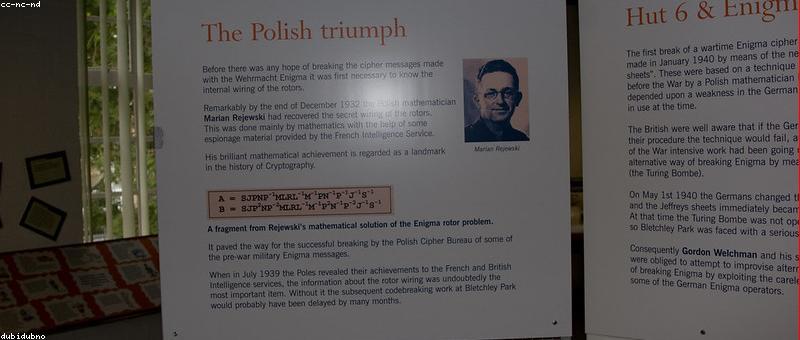
For years, the Enigma was believed to be an impenetrable cipher. Nazi Germany relied on this assumption, using the machine to secure its most sensitive military communications throughout the war. However, a team of brilliant Polish mathematicians and cryptanalysts would soon prove this notion wrong.
In the early 1930s, Polish intelligence had already made significant strides in understanding the Enigma's inner workings. When World War II broke out, the Poles shared their knowledge with their British and French allies, kickstarting a race to crack the Enigma code.
"The Enigma was the most complex cipher device ever invented. Its security depended on the secrecy of its ever-changing settings, which were changed daily. Breaking the Enigma code was one of the greatest intellectual feats of World War II." - Andrew Hodges, biographer of Alan Turing
Enter Alan Turing, the brilliant British mathematician and computer pioneer. Turing and his team at Bletchley Park developed groundbreaking techniques, including the use of electromechanical "bombes" to systematically test millions of possible Enigma settings. Their efforts, combined with intelligence gathered by the Polish Cipher Bureau, allowed the Allies to read a significant portion of Nazi Germany's encrypted communications. This intelligence proved invaluable, shaping the course of the war and hastening the Allied victory.
The Enigma's Legacy
The Enigma machine's legacy extends far beyond its wartime exploits. Its design and engineering principles have had a profound impact on the field of cryptography, inspiring the development of modern encryption methods and computer science. The Enigma's complex rotor system, for example, laid the groundwork for the creation of subsequent cipher machines and the study of computational complexity.
But the Enigma's true legacy lies in the remarkable individuals who dedicated their talents to cracking its code. The codebreakers at Bletchley Park, including Turing, Dilly Knox, and Joan Clarke, are now celebrated as heroes of the war effort, their accomplishments shining a light on the crucial role of intelligence and technology in modern warfare.
The Enduring Fascination
Even decades after the war, the Enigma machine continues to captivate the public imagination. Its enigmatic nature, the high-stakes drama of the code-breaking efforts, and the larger-than-life personalities involved have all contributed to the Enigma's enduring mystique. From novels and films to museum exhibits and collector's items, the Enigma machine remains a testament to the power of human ingenuity, perseverance, and the never-ending struggle between secrecy and transparency.
Comments