Charles Babbage
The deeper you look into charles babbage, the stranger and more fascinating it becomes.
At a Glance
- Subject: Charles Babbage
- Category: Computer Science, Mathematics, History of Science
Charles Babbage was a true polymath – a 19th century genius whose visionary ideas and inventions would shape the course of computer science and mathematics for centuries to come. While his Analytical Engine was never fully realized in his lifetime, it laid the conceptual groundwork for the modern digital computer.

A Clockmaker's Son with Grand Ambitions
Born in 1791 in Southwark, London, Charles Babbage was the son of a successful bank owner and clockmaker. From an early age, young Charles displayed an insatiable curiosity and proclivity for mathematics, mechanics, and invention. He excelled in his studies, graduating from Cambridge University with a degree in mathematics.
It was during this time that Babbage's mind began to drift towards the idea of a "thinking machine" – a mechanical device capable of performing complex calculations with speed and accuracy far beyond human capabilities. This notion was the seed that would grow into his life's work, shaping the trajectory of computer science for generations to come.
Conceptualizing the Analytical Engine
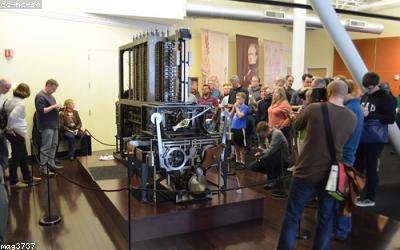
In 1822, Babbage unveiled his first major invention, the Difference Engine – a machine designed to tabulate polynomial functions and print mathematical tables. This was a revolutionary concept, as prior to this, all mathematical calculations were performed manually. The Difference Engine, while an impressive feat of engineering, was merely a precursor to Babbage's true ambition: the Analytical Engine.
Babbage spent the better part of three decades designing and refining the plans for the Analytical Engine, collaborating with Ada Lovelace, a brilliant mathematician who developed algorithms for the hypothetical machine. However, due to a lack of funding and technological limitations of the time, the Analytical Engine remained unbuilt during Babbage's lifetime.
The Father of the Computer
Despite never seeing his grand vision fully realized, Charles Babbage is widely regarded as the father of the computer. His pioneering work on the Analytical Engine laid the foundation for the modern digital computer, including the concepts of input, output, storage, and programming.
"We may say most aptly that the Analytical Engine weaves algebraical patterns just as the Jacquard-loom weaves flowers and leaves." - Ada Lovelace, describing Babbage's Analytical Engine
Babbage's influence can be seen in the work of later computer pioneers, such as Alan Turing and John Atanasoff, who built upon his ideas to develop the first functioning electronic computers. His legacy as a visionary thinker and trailblazer in the field of computer science is secure, and his name is forever etched in the annals of technological history.
A Life of Innovation and Controversy
Beyond his groundbreaking work on the Analytical Engine, Charles Babbage was a true Renaissance man, involved in a wide range of scientific and social pursuits. He was an accomplished astronomer, inventor, and reformer, advocating for improvements in everything from transportation to the postal service.
Babbage's relentless drive and unconventional nature, however, often put him at odds with the establishment. He was a vocal critic of the British government and scientific community, which he felt were resistant to innovation and progress. This confrontational attitude, combined with his ambitious but unfinished projects, led to a degree of controversy and skepticism during his lifetime.
Nevertheless, Charles Babbage's legacy as a visionary thinker and pioneering inventor remains secure. His ideas and concepts have had a profound and lasting impact on the world of computer science and technology, and his name is synonymous with the birth of the modern digital age.
Comments