Bird Flocks
The untold story of bird flocks — tracing the threads that connect it to everything else.
At a Glance
- Subject: Bird Flocks
- Category: Ornithology, Ecology
The Mesmerizing Mystery of Bird Flocks
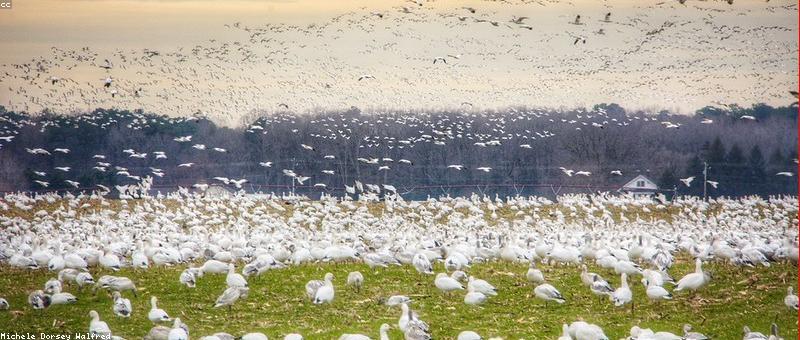
Imagine yourself standing in an open field, watching as a massive flock of birds lifts off in perfect unison, their wings beating in a hypnotic rhythm. It's a sight that has captivated humanity for millennia, and yet the true nature of these avian choreographed dances remains shrouded in mystery.
What unseen forces guide the movements of these feathered formations? How do thousands of individual birds coordinate their flights with such precision, shifting and swerving as a single, fluid entity? The answers, it seems, lie at the intersection of biology, physics, and even the limits of our own understanding.
The Emergence of Collective Intelligence
At the heart of this phenomenon lies a remarkable example of collective intelligence in the natural world. Each bird in a flock may be following relatively simple rules - maintain a certain distance from your neighbors, match their speed and direction - but the cumulative effect is the birth of a higher-order intelligence that transcends the individual.
Researchers have likened this emergence of flockwide coordination to the behavior of swarm systems in the insect world, where complex group dynamics arise from simple individual rules. But the avian version presents a unique challenge - birds are much larger and more cognitively sophisticated than ants or bees, yet they still manage to achieve this uncanny level of collective synchronization.
The Physics of Flocking
One key to understanding bird flocks lies in the physical forces at play. Aerodynamic principles, such as the vortex dynamics created by a bird's flapping wings, play a crucial role in how flocks maintain their cohesion and efficiency.
"The movements of a flock can be likened to a fluid, with the birds acting as molecules in a continually shifting, swirling pattern. It's a breathtaking example of natural self-organization." - Dr. Julia Parrish, University of Washington
By positioning themselves in relation to their neighbors' wakes, birds are able to conserve energy and take advantage of the uplift generated by the flock as a whole. This "distributed sensing" allows the birds to react and adjust in real-time, anticipating the movements of the group rather than relying solely on their individual senses.
The Evolutionary Advantages of Flocking
But the significance of bird flocks extends far beyond their impressive aerodynamics. From an evolutionary perspective, flocking confers a number of critical advantages that have shaped the development of avian species over millennia.
By banding together in large numbers, birds gain protection from predator swarms that would overwhelm a lone individual. The sheer size and unpredictability of a flock makes it a daunting target, while the continuous flow of information within the group allows for rapid, coordinated evasive maneuvers.
Moreover, flocking behavior may also confer foraging advantages, as birds can pool their knowledge of food sources and take advantage of the collective vigilance to feed more efficiently. The social nature of flocks has even been linked to enhanced cognitive abilities, as birds learn from their neighbors and develop more sophisticated survival strategies.

The Future of Flocking
As our understanding of bird flocks continues to evolve, scientists are exploring new frontiers in this captivating field. From the development of swarm robotics inspired by avian behavior to the potential applications of flocking principles in urban planning and traffic management, the lessons of bird flocks are proving to have far-reaching implications.
Yet even as we unravel the complexities of this natural phenomenon, the sheer beauty and wonder of witnessing a massive flock in motion remains a testament to the enduring mysteries of the avian world. For in the seamless choreography of these feathered dancers, we catch a glimpse of the profound interconnectedness that underpins the natural order - a revelation that continues to captivate and inspire us, even as we strive to fully comprehend its depths.
Comments